

16.07.2026
Alesya Mozol: How to become the youngest doctoral student at BGEU and build a career in science
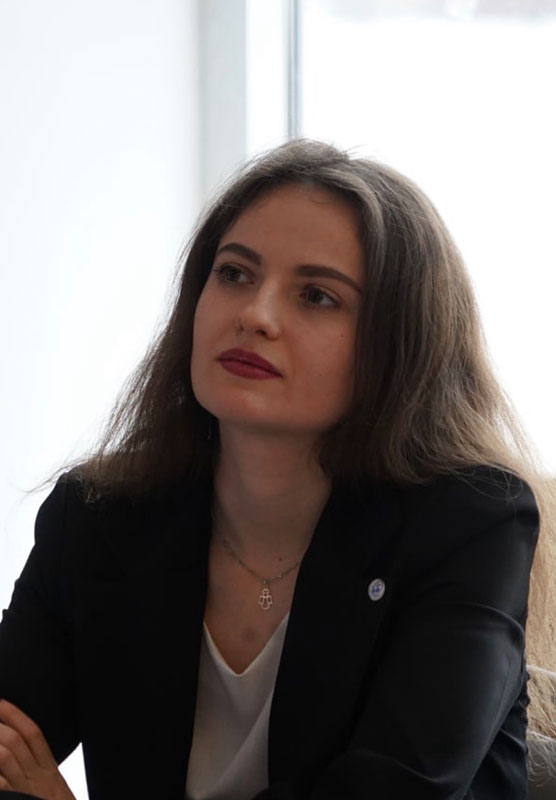
Being the university's youngest doctoral student is not only an honorary status but also a serious challenge, requiring iron discipline and dedication. Alesya Aleksandrovna Mozol, PhD in Economics and Associate Professor in the Department of Mathematical Methods in Economics at BGEU, shared her experience and opinion on how a systematic approach to scientific research helps achieve ambitious goals.
— Alesya Aleksandrovna, you are close to completing your doctoral dissertation, becoming the youngest doctoral student at BGEU. How did you decide to choose such a serious and challenging career in science? What was the biggest challenge for you during your research?
— My path to science developed gradually. Even during my studies in economic cybernetics, I developed a strong interest in mathematical research, especially the application of mathematical methods in economics. This field requires systems thinking, high concentration, and a willingness to work with fairly complex models, but this research logic has always resonated with me.
The topic of my doctoral dissertation is related to modeling priority development areas for high-tech sectors of the agro-industrial complex in the context of digital transformation. For me, this is an important and meaningful research problem, as it lies at the intersection of economics, mathematical modeling, and the analysis of modern technological change.
The decision to continue my scientific career and pursue a doctoral research degree wasn't a sudden one. It evolved gradually, as I gained experience, published, and taught, and realized that the chosen topic had the potential for further serious study.
Being the youngest doctoral student at BGEU is certainly a great honor, but also a huge responsibility. This status obliges me to demonstrate with tangible results that age is not a determining factor in great science. Much more important are preparation, discipline, a strong academic background, and the ability to consistently work on a complex research problem.
The biggest challenge during my dissertation work was finding and systematizing the data necessary for the study. Moreover, it's challenging to combine research with teaching, publishing, and other professional responsibilities. In such a situation, self-organization, the ability to prioritize, and maintain consistency in your work are especially important.
My university education helped me a lot. Studying in economic cybernetics was challenging, but it shaped my professional foundation, analytical thinking, and resilience to complex problems. I believe this training greatly helped me move forward in my research.
— The Department of Mathematical Methods in Economics is a place where abstract formulas meet real business processes. How would you explain to a first-year student why no successful economic strategy is possible today without mathematics?
— I try to explain the importance of mathematics in economics through real, understandable examples. If you immediately talk to a first-year student about complex models, optimization problems, or econometric methods, it might seem too abstract. But if you start with a simple situation: "You have 100 rubles..." the logic becomes clearer, and the students become engaged. At this point, the student sees that mathematics helps not just calculate, but make informed decisions.
In the modern economy, almost every strategy involves making choices: where to allocate resources, how to assess risks, how to forecast demand, how to determine project effectiveness, how to allocate investments. All these tasks require calculations, models, and data analysis. Without a mathematical framework, management decisions often remain intuitive, and in a highly competitive environment, intuition alone is no longer enough. This is especially noticeable in the context of digital transformation. Today, the economy operates with large data sets, algorithms, forecasting systems, and elements of artificial intelligence. To understand these processes and apply them in practice, an economist must possess mathematical thinking. Mathematics allows one to see patterns, test hypotheses, evaluate the consequences of decisions, and choose the most rational development path.
Therefore, I would say that mathematics in economics is not an independent abstraction, but a tool for analyzing reality. It helps translate complex economic processes into the language of models, calculations, and concrete conclusions. That's why it's impossible to build a sustainable and successful economic strategy today without mathematical methods.
— Doctoral studies, teaching, scientific publications... How do you manage to maintain balance and avoid burnout under such a high intellectual load? Do you have a secret that helps you maintain a clear mind and the desire to move forward?
— Combining doctoral studies, teaching, publishing activity, and your current professional responsibilities is indeed challenging. In practice, this requires a high level of self-organization and a willingness to work very intensively. There are times when I have to do research late in the evening, at night, or on weekends because my regular work schedule doesn't always allow for in-depth research.
I can't say that a perfect balance is always achievable. There are periods in research when the workload objectively increases, especially if I'm simultaneously teaching, preparing publications, participating in conferences, and working on a dissertation. In such circumstances, it's important to be able to prioritize and understand which tasks require the most attention.
My main resource remains intrinsic motivation. If the research topic is truly interesting, if you see scientific and practical value in it, then this helps me continue working even under heavy workload. In a sense, there's simply no time for burnout because I have a specific goal, deadlines, and responsibilities to myself, the department, the university, and the scientific school.
A systematic approach helps me: planning tasks, working through materials sequentially, dividing a large study into individual stages. When a complex task is broken down into clear steps, it's easier to tackle psychologically and professionally. So for me, the secret isn't in some universal recipe, but in discipline, motivation, and the ability to stay focused on the end result.
— You teach students just starting out in science. How do you see students changing? What most excites young people today, and what qualities do you, as a teacher, strive to develop in them first?
— I believe that students are becoming more independent every year and are offering increasingly innovative approaches to problem solving. This is especially noticeable during practical classes, when the same problem can be solved in different ways. Working with students not only allows you to impart knowledge but also provides the opportunity to continually learn, staying abreast of the latest trends.
Today, students are showing a clear interest in information technology, artificial intelligence, data analysis, and the practical application of economic knowledge. It's important for them to understand where exactly they can use the skills they've acquired, how this knowledge relates to their future profession, and what opportunities it opens up. Therefore, in my opinion, modern teaching should be based not only on theory but also on real-world examples, applied problems, and connections to current technological processes. First and foremost, I strive to develop in my students analytical and critical thinking, independence, discipline, the ability to work with data, and responsibility for results. It's important for students to not simply memorize material, but to learn to reason, test hypotheses, see cause-and-effect relationships, and draw well-founded conclusions.
For me, students are especially important. I often say to myself, "People are treasures." My students are my pride, and I always sincerely rejoice in their successes, even if at some point they surpass my own. Moreover, I consider this the right culmination of my teaching. My professional motto can be formulated as follows: "A good teacher is one whose student has surpassed their teacher." If a student develops, achieves significant results, and moves on, then my teaching has not been in vain.
— In short, what is your work about? What innovative approaches or solutions do you propose in your research that could be useful for the Belarusian economy in the coming years?
— In short, my work is devoted to modeling priority development areas for high-tech sectors of the agro-industrial complex in the context of digital transformation. The study examines how mathematical modeling, mixed-frequency data, and foresight management tools can be used to more effectively assess promising development areas and make decisions based on calculations, not just expert assumptions.
The scientific novelty of this work lies in the application of this approach to problems in the agro-industrial complex of the Republic of Belarus within the framework of specialty 08.00.13 – "Mathematical and Instrumental Methods of Economics." The calculations are performed using Python, which allows for data processing, model building, and obtaining analytical results in a more flexible and reproducible format. The practical value of the study lies in the fact that the proposed approaches can be used to determine development priorities, assess the prospects for digital transformation, and improve the validity of management decisions in high-tech sectors of the agro-industrial complex.
— There's a stereotype that big science is an exclusively male domain, requiring iron-fisted endurance. What challenges have you encountered along the way, and what would you say to those who doubt that a young woman can become a successful PhD candidate?
— I disagree with the stereotype that big science is an exclusively male domain. In my opinion, what matters in scientific endeavors isn't gender or age, but professional training, discipline, hard work, the quality of the research, and the results obtained. Science is objective by nature: what matters is how well-founded the conclusions are, how sound the methodology is, and what contribution the work makes to the development of the specialty.
Of course, there have been various challenges along the way. These include the high workload, the need to combine doctoral studies with teaching, the constant work on publications, and the need to confirm one's professional level. Age also plays a role, as younger researchers are sometimes treated with more scrutiny and demanding attitudes. But I don't see this as an obstacle, but rather as an additional incentive to work systematically and effectively. My academic background, my department, and the support of my colleagues greatly help me. When you have a professional environment that values knowledge, methodology, and conscientious work, it's much easier to move forward. I believe that a successful scientific career is possible even at a young age. Moreover, it's precisely at this age that you often have a lot of energy, a flexible mindset, and a willingness to juggle several fields simultaneously.
To those who doubt that a young woman can become a successful PhD candidate, I would answer simply: you need to look at results. If you have a serious topic, scientific novelty, publications, teaching experience, and a willingness to work on complex problems, then gender is irrelevant. In science, professional results always remain the most important factor.
— BGEU is an entire scientific school. Which of your mentors at the university influenced you most? Is there a professional principle you adopted from your teachers and now pass on to your students?
— BGEU is truly an important scientific school for me. My professional development was influenced by the faculty of the Department of Mathematical Methods in Economics, as well as my academic supervisor. It was in this environment that I developed the understanding that scientific work requires not only knowledge but also discipline, methodological rigor, responsibility for conclusions, and a constant willingness to develop.
Among the professional principles I adopted from my mentors and now pass on to my students, I would highlight several key ones. First, any conclusion must be justified. Second, complex concepts must be explained clearly. Third, in science, it is important not to settle for ready-made answers, but to be able to ask questions, test hypotheses, and seek more precise solutions. For me, this is the foundation of both research and teaching.
— What would you say to those currently at a crossroads, considering whether to pursue a career in science at BGEU or a career in business?
— I would encourage them to choose not only based on the apparent appeal of a field, but above all on their own intrinsic interest. In my opinion, it's important to pursue what you truly love, because both science and business require serious dedication, discipline, and a willingness to constantly evolve.
At the same time, I don't believe science and business should be strictly opposed. Scientific training at BGEU provides a strong methodological foundation, develops analytical thinking, the ability to work with data, see cause-and-effect relationships, and make informed decisions. These qualities are in demand not only in academia but also in business, especially in the context of the digital economy, the development of artificial intelligence, financial analytics, and the management of complex systems.
If someone chooses science, they should understand that this is a path of systematic and long-term work. But this path provides the opportunity to deeply explore complex issues, develop new approaches, and contribute to the development of one's professional field. If one chooses business, scientific thinking can also be a significant advantage, because modern businesses need specialists who can not only act quickly but also make decisions based on analysis.
Therefore, my advice is simple: choose a field that truly interests you and don't be afraid to combine a scientific approach with practical tasks. BGEU provides a good foundation for this, and then much depends on personal motivation, hard work, and a willingness to apply the acquired knowledge in real-world professional settings.


International relations dep.
Tel.: (+375 17) 209-88-32,
e-mail: umoms@bseu.by
International students office:
Tel.: (+375 17) 209-79-71